When budgeting for commercial or residential landscaping, the pile height of synthetic turf serves as a primary pivot point for both aesthetics and cost. A 25mm pile height is often regarded as the "golden mean," offering a balance between the low-profile look of sports carpets and the plush feel of luxury residential lawns.
However, determining the exact 25mm artificial grass price involves more than just measuring length. It requires an understanding of gauge, stitch rate, and the polymer density used in the manufacturing process, all of which dictate the longevity and resilience of the surface.
This guide examines the technical variables that influence pricing and how to evaluate the value of mid-pile synthetic turf across different industrial and domestic applications.


Pile height is the vertical measurement of the synthetic fiber from the backing to the tip. In the plastics industry, specifically within synthetic fiber production, the 25mm specification is a critical threshold. It is short enough to remain durable under moderate foot traffic but long enough to provide the "spring" associated with natural grass.
From an economic standpoint, the raw material consumption increases linearly with pile height. However, 25mm turf often hits a pricing sweet spot because it utilizes standard extrusion processes without requiring the extreme stabilization needed for very long-pile luxury turf.
Beyond the simple 25mm measurement, the "face weight" is the most significant driver of the 25mm artificial grass price. Face weight refers to the total weight of the yarn per square meter. A higher face weight indicates a denser product with more stitches per square inch, which naturally increases the cost of production but significantly improves the product's ability to recover from compression.
The "gauge" or the distance between the rows of stitches also plays a role. A tighter gauge creates a more uniform appearance and prevents the backing from showing through (known as "thinning"). Manufacturers must balance the gauge and stitch rate to optimize the density without making the product overly rigid, which would compromise the tactile experience.
Furthermore, the shape of the fiber—whether it is a simple C-shape, a W-shape, or a complex diamond-shaped profile—affects how the grass stands upright. Specialized fiber shapes require more complex extrusion dies and higher precision during the tufting process, adding a premium to the final unit price.
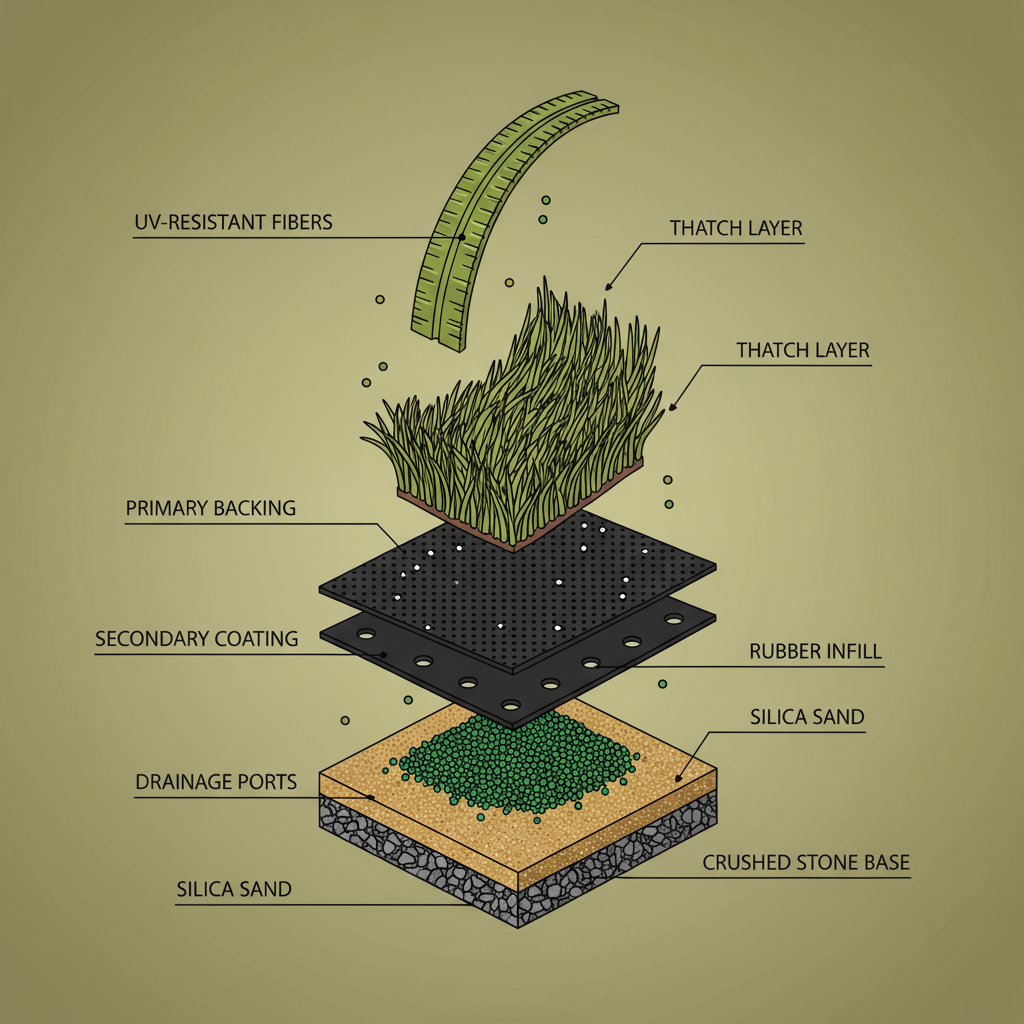
The chemistry of the polymer is what separates industrial-grade turf from budget alternatives. Most high-performance 25mm turf is constructed from Polyethylene (PE) for the blades due to its softness and durability, while Polypropylene (PP) is often used for the thatch (the curly fibers at the base) to provide structural support.
The integration of UV-stabilizers and environmentally friendly polymer additives during the extrusion phase is the primary determinant of a product's lifespan, preventing the "sun-bleaching" effect common in low-grade plastics.
For projects where environmental safety is paramount, the use of non-toxic, lead-free polymers is non-negotiable. This shift toward sustainable chemistry in the non-metallic mineral and plastic products industry has slightly increased the base cost of materials but has drastically improved the safety profile for pet training and children's play areas.
When comparing various pile heights, 25mm represents a balanced investment. While shorter 12mm-15mm turf is cheaper and ideal for exhibitions, it lacks the aesthetic realism required for landscaping. Conversely, 40mm+ turf is highly realistic but requires more intensive brushing and maintenance to prevent matting.
The value of 25mm turf is best realized in "multi-use" environments. Its moderate density allows for efficient drainage while remaining soft enough for barefoot contact, reducing the long-term cost of ownership by minimizing the need for specialized grooming equipment.
An emerging application for synthetic turf is in urban construction site management. Building enclosure artificial turf, such as those provided by HOYARN, transforms traditional construction hoardings into green corridors. By combining a support structure (metal or wood) with a precision-processed PE/PP turf material, cities can reduce the visual blight of construction sites.
These specialized installations offer more than just aesthetics. The turf acts as a functional barrier that absorbs dust and reduces noise pollution from the construction site. Furthermore, it improves pedestrian safety by providing a physical and visual buffer, and can be customized with corporate logos to turn a functional fence into a branding opportunity.
The global synthetic grass market is moving away from generic "green carpets" toward application-specific engineering. We are seeing a rise in "smart turf" that incorporates enhanced antimicrobial properties for pet training areas or high-impact resilience for sports and entertainment zones.
Cost structures are also evolving. While raw polymer prices fluctuate based on petroleum markets, the industry is seeing a shift toward recycled polymer blends. This not only reduces the environmental footprint but also allows manufacturers to offer a wider range of price points for 25mm products without sacrificing structural integrity.
As urban density increases, the demand for "indoor home artificial grass" is growing. This requires a different technical approach, focusing on softer fiber textures and VOC-free (Volatile Organic Compound) materials to ensure indoor air quality, which typically carries a different pricing model than outdoor commercial turf.
Selecting the right turf requires a systematic evaluation of the environment. A residential backyard requires a different density than a public walkway or a construction hoarding. The goal is to match the fiber resilience to the expected "load" of the application.
Buyers should avoid focusing solely on the per-square-meter price. A cheaper 25mm turf with a low stitch rate will flatten quickly, leading to higher replacement costs. The true metric is the "lifecycle cost," which includes the initial purchase, installation, and the frequency of maintenance or replacement.
The following framework provides a relative suitability guide for 25mm artificial grass based on common use-case requirements.
| Scenario | Traffic Level | Key Requirement | Relative Suitability |
|---|---|---|---|
| Residential Lawn | Low to Medium | Softness / Aesthetics | High |
| Pet Training Area | Medium | Drainage / Durability | Very High |
| Construction Fence | Low (Visual) | Dust Reduction / Noise | Optimal |
| Indoor Decor | Low | VOC-Free / Texture | High |
| Sports Field | High | Impact Absorption | Moderate |
| Public Walkway | Very High | Abrasion Resistance | Moderate |
The price is primarily driven by the face weight (density of the fibers), the quality of the polymer (PE vs PP), and the complexity of the fiber shape. Higher density and specialized UV-stabilized materials increase the cost but ensure the grass remains upright and color-fast over several years of exposure.
Yes, 25mm is often ideal for pets. It is long enough to feel natural and comfortable for animals, yet short enough that it doesn't trap debris or waste as deeply as 40mm turf, making it much easier to clean and sanitize while maintaining excellent drainage.
While both may use similar fibers, construction turf is designed for vertical or semi-vertical installation on hoarding fences. It focuses more on sound insulation, dust absorption, and visual camouflage for urban landscapes rather than the foot-traffic resilience required for a residential lawn.
Absolutely. Indoor artificial grass is popular for home decor and offices. When selecting for indoors, prioritize "Indoor Home Artificial Grass" options that use VOC-free materials to ensure there are no chemical odors or off-gassing in enclosed spaces.
Check the face weight and backing material. If a 25mm product is significantly cheaper than the market average, it often has a low stitch rate or a flimsy backing. This leads to "flattening" within months, meaning the long-term cost of replacement will outweigh the initial savings.
With high-quality UV-stabilized polyethylene and proper installation, professional-grade 25mm turf typically lasts 8 to 15 years. Lifespan depends on the intensity of use and the quality of the polymer used during the manufacturing process.
Navigating the 25mm artificial grass price landscape requires a shift in perspective from "cost per square meter" to "value per year of use." By analyzing density, polymer chemistry, and application-specific needs, buyers can ensure they invest in a surface that maintains its aesthetic and functional integrity over time.
Whether it is for a residential oasis, a pet-friendly zone, or an innovative urban construction enclosure, the mid-pile 25mm specification remains one of the most versatile tools in modern synthetic landscaping.